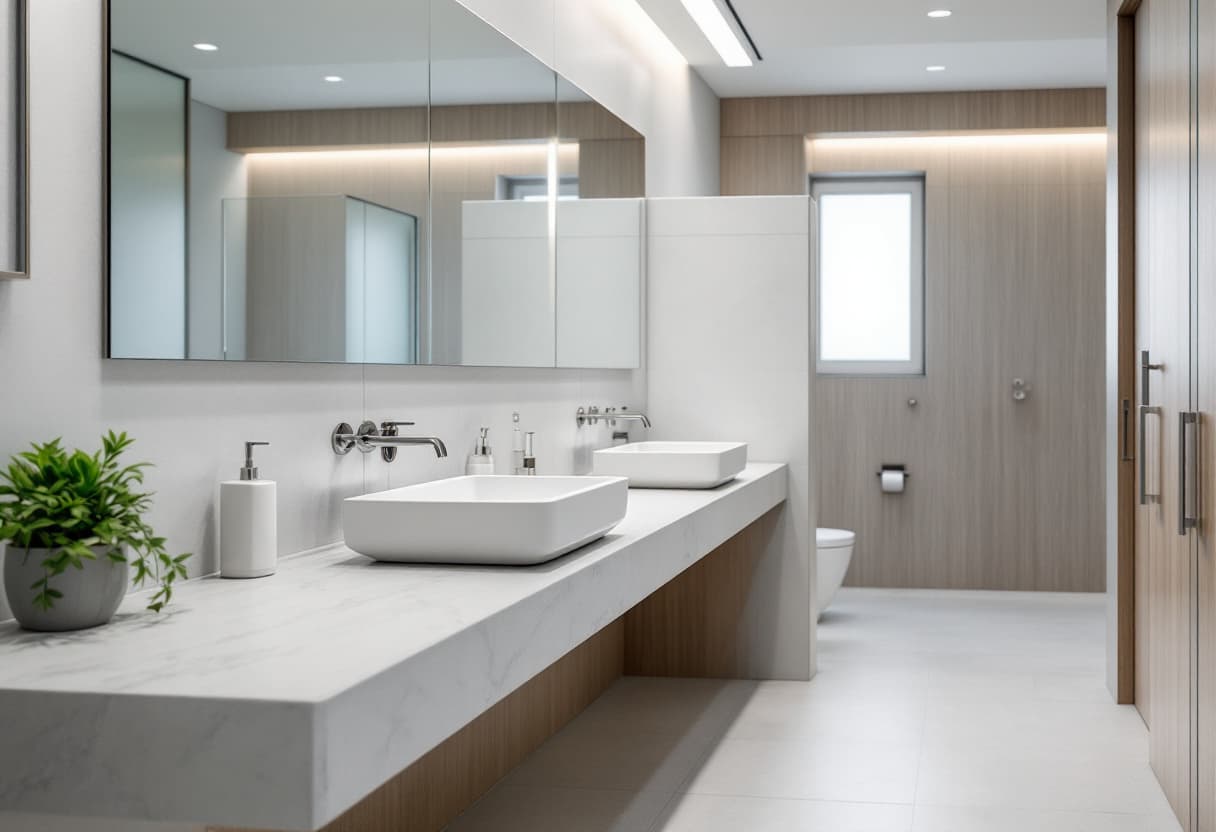
Ask a facility manager which room carries the most reputational risk and most will point to the lobby. They're wrong. It's the restroom. A visitor forgives a scuffed baseboard or a fingerprinted glass door, but a restroom that smells, streaks, or runs out of paper leaves an impression no amount of front-desk polish can undo. It's the one space where every occupant experiences, up close and privately, how seriously your building takes hygiene.
It's also the hardest room in the building to actually clean, and the easiest to fake. This guide breaks down what real commercial restroom sanitation looks like, why "wiped down" and "sanitized" are not the same thing, and how businesses across Reno and Sparks, Carson City and Dayton, Minden and Gardnerville, and Lake Tahoe can tell the difference.
Cleaning and Sanitizing Are Two Different Jobs
The single most important thing to understand about restrooms is that appearance and hygiene are not the same standard. A surface can look spotless and still carry a heavy microbial load; it can look slightly hazy and be genuinely sanitary. Good restroom care hits both bars, and it does them in the right order.
- Cleaning physically removes soil, films, and organic matter from a surface. It's the necessary first step — disinfectant can't reach a pathogen buried under a layer of grime.
- Disinfecting then kills the pathogens on that now-clean surface. This is where most cut-rate cleaning fails: the disinfectant is sprayed and immediately wiped away, giving it no time to work.
That timing detail — dwell time, also called contact time — is the technical heart of restroom sanitation. Every EPA-registered disinfectant has a required wet dwell time printed on its label, usually somewhere between one and ten minutes, during which the surface must stay visibly wet to actually kill what the label claims. Spray-and-wipe in a single motion doesn't sanitize anything; it just relocates the germs. A trained crew sprays surfaces, moves on to another task, and returns to wipe only after the dwell time has elapsed.
Where the Germs Actually Live
People assume the toilet is the dirtiest surface in a restroom. It's usually not. The heaviest contamination sits on the surfaces hands touch on the way in and out — which is exactly why a real sanitation protocol prioritizes them:
- Door handles and push plates — the last thing a person touches on the way out, often right after they've handled everything else.
- Faucet handles and flush levers — touched with unwashed hands by definition.
- Stall latches, dispenser buttons, and light switches — high-frequency contact, almost never cleaned by occupants.
- Countertops around sinks — where splash, soap residue, and hands all meet.
This is the argument for touch-free fixtures — automatic faucets, flush valves, soap and towel dispensers — which remove the most contaminated touchpoints entirely. But hardware only reduces the surfaces; it doesn't eliminate the need for a disciplined disinfection pass on everything that hands still reach.
Odor Control Is a Cleaning Problem, Not a Fragrance Problem
The fastest way to spot a poorly maintained restroom is to walk in and smell it — and the fastest way to spot a lazy program is to smell air freshener layered on top of the odor. Masking scent doesn't remove the source; it just tells occupants you know there's a problem and chose to cover it.
Persistent restroom odor almost always traces to one of three sources, none of which a plug-in air freshener touches:
- Uric-acid buildup around the base of toilets and urinals and in floor grout. Urine salts crystallize into grout and caulk lines and continue releasing ammonia odor until they're broken down with an enzymatic or acidic cleaner — a mop and general-purpose cleaner won't lift them.
- Dry floor drains. In Northern Nevada's dry air, the water in a floor-drain trap evaporates faster than facility managers expect. Once the trap runs dry, sewer gas vents straight up into the room. A cup of water down each drain on a regular schedule is the entire fix — and it's the most common cause of a "mystery smell" that survives every cleaning.
- Grout and porous flooring. Restroom grout is a sponge for everything that hits the floor. Once it's saturated, it holds odor that surface mopping can't reach, which is why periodic deep grout cleaning belongs in any serious restroom program.
We covered dry-trap prevention and other between-visit habits in our guide to keeping a facility cleaner between professional visits — the mid-day restroom reset is one of the highest-return habits an in-house team can run.
The Cross-Contamination Trap
Here is the failure that undoes an otherwise diligent cleaning: using the same cloth on the toilet and then on the sink counter. It looks like cleaning. It's actually spreading contamination across every surface the cloth touches, in order of dirtiest to cleanest.
Professional restroom crews prevent this with color-coded microfiber systems — a dedicated color for toilets and urinals, a different color for sinks and counters, another for mirrors and glass, another for general surfaces. Cloths are never crossed between zones, and they go into a laundry bag after one use rather than being rinsed and reused. This is standard practice in healthcare cleaning and increasingly the expectation in any professional office program. It's a simple system, and its absence is one of the clearest signs a provider is cutting corners.
Supply Reliability Is Part of Sanitation
A technically perfect cleaning means nothing if the soap dispenser is empty by 10 a.m. Hand hygiene is the front line of restroom sanitation, and it depends entirely on supplies being there when someone needs them. A real program treats restocking as a monitored responsibility, not an afterthought:
- Soap, paper towels, toilet paper, and seat covers checked and topped off every service visit, with buffer stock on site.
- Dispensers matched to actual traffic — a busy lobby restroom needs higher-capacity units than a back-office one.
- A mid-day check on high-occupancy floors, because a restroom that's stocked at 6 a.m. can be stripped bare by lunch in a full building.
How Often Should Commercial Restrooms Be Cleaned?
OSHA's sanitation standard (29 CFR 1910.141) requires employers to keep restrooms clean and sanitary, but deliberately doesn't dictate a frequency — the practical, case-law-backed standard is "often enough to stay sanitary throughout the workday." In real terms, for Northern Nevada facilities that means:
- General office restrooms: a full clean-and-disinfect every service visit, typically daily, with restocking each time.
- High-traffic and public restrooms (lobbies, retail, medical waiting areas): daily full service plus one or more mid-day resets — restock, wipe touchpoints, clear the floor.
- Medical and clinical restrooms: driven by protocol and dwell-time documentation, not appearance alone. See our approach to medical office cleaning.
The compliance side of this — SDS documentation, product selection, and where in-house cleaning quietly falls short of OSHA's expectations — is covered in our guide to OSHA compliance for Northern Nevada businesses. And if you're not sure how often your building as a whole should be serviced, our cleaning frequency guide walks through reading traffic patterns and setting a cadence.
What a Real Restroom Protocol Looks Like
Put together, a professional restroom service runs in a deliberate sequence rather than a random wipe-around:
- Restock first so nothing runs out mid-shift.
- Apply disinfectant to fixtures — toilets, urinals, sinks — and let it dwell while other work happens.
- Clean surfaces top-down with a color-coded cloth per zone: mirrors and dispensers, then counters, then partitions and touchpoints.
- Return to the dwelled fixtures and wipe them down now that the disinfectant has done its job.
- Floors last — sweep, then damp-mop with fresh solution, working toward the door, with attention to the grout and the base of fixtures where odor hides.
- Flush floor drains and do a final touchpoint pass on the way out.
None of this is exotic — it's just disciplined, done the same way and in the same order every time. That consistency is the entire difference between a restroom that stays sanitary and one that only looks clean for the first hour after the crew leaves.
The Bottom Line
Restroom sanitation is where a cleaning program is judged. Getting it right isn't about a stronger chemical or a nicer air freshener — it's about dwell time, touchpoint discipline, color-coded cross-contamination control, odor sources addressed at the root, and supplies that never run out. If your restrooms smell by mid-afternoon, streak after cleaning, or run dry before the day is over, the problem isn't the room. It's the program behind it.
Benchmark builds restroom sanitation into office cleaning and janitorial programs around each building's real traffic — with dwell-time-correct disinfection, color-coded systems, and restocking treated as part of the job, not a courtesy. Restroom floor and grout care is coordinated with our broader floor care program so odor at the source gets handled, not masked. Call (775) 530-0456 or request a free quote and we'll walk your facility with you.
Related Reading
Ready for a Cleaner Workspace?
Get a free, no-obligation cleaning plan customized for your Northern Nevada business.