Northern Nevada's fire season runs roughly from June through October, and it doesn't require a fire burning nearby to affect local air quality. Smoke from wildfires in the Sierra Nevada, Northern California, and even fires several hundred miles away routinely drifts into the Reno-Sparks valley, settles into the Lake Tahoe basin, and sits over Carson City and Dayton for days at a time. On the worst air-quality days, Reno and Tahoe have both landed among the most smoke-affected metro areas in the country — even when the nearest active fire is well outside Nevada.
For facility managers and business owners, smoke season raises a question that doesn't come up the rest of the year: what actually protects the air inside your building when the air outside is unhealthy? The honest answer involves three things working together — HVAC filtration, cleaning protocol changes, and a few structural habits (door and window management, portable filtration) that most commercial buildings aren't set up for by default.
Why Wildfire Smoke Is a Workplace Issue, Not Just an Outdoor One
Wildfire smoke's primary health hazard is fine particulate matter, PM2.5 — particles roughly 30 times smaller than the width of a human hair. PM2.5 is small enough to bypass the body's normal filtering (nose hair, mucus membranes) and lodge deep in the lungs, where it's linked to respiratory irritation, aggravated asthma and COPD, cardiovascular strain, and headaches and fatigue even in otherwise healthy adults. It's also small enough to work its way into buildings through gaps most people never think about: door thresholds, operable windows, loading dock doors left open for deliveries, and — the biggest pathway — HVAC systems pulling in outdoor air.
A building doesn't need visible haze indoors for smoke to be a problem. Indoor PM2.5 levels during a heavy smoke event commonly run 30–70% of outdoor levels in buildings without upgraded filtration, which is enough to move indoor air quality from "good" to "unhealthy for sensitive groups" on a bad day. Employees who work eight-hour shifts in that air are getting meaningfully more exposure than someone walking through it outside for a few minutes.
How Smoke Actually Gets Inside
- HVAC outdoor air intake: Most commercial HVAC systems are designed to bring in a percentage of fresh outdoor air for ventilation. During a smoke event, that intake becomes the largest entry point for particulate — the system is, by design, pulling smoke into the building continuously.
- Door and dock activity: Retail entrances, restaurant doors, and warehouse loading docks that open frequently let smoke-laden air in with every open-close cycle. High-traffic entrances during a smoke event let in disproportionately more particulate than the rest of the building envelope combined.
- Building envelope leaks: Older commercial buildings, and any building with operable windows, have gaps around window frames, utility penetrations, and roof access points that let fine particulate infiltrate slowly over the course of a smoke event, even with everything closed.
- Foot traffic: Ash and settled particulate on parking lots, sidewalks, and entry mats gets tracked indoors on shoes, then redistributed across floors and carpet by normal foot traffic.
HVAC and Filtration: What Facility Managers Should Actually Do
Filtration is the highest-leverage lever a facility has during smoke season, and it's usually underused because most buildings run whatever filter came standard.
Upgrade Filter Rating for the Season
Standard commercial HVAC filters are often rated MERV 8 — adequate for dust and pollen, poor at capturing PM2.5. MERV 13 is the generally recommended minimum for meaningful wildfire-smoke filtration; MERV 13 filters capture a large majority of PM2.5-sized particles compared to a small fraction for MERV 8. Not every HVAC system can run a MERV 13 filter without a static-pressure and airflow assessment first — a system not designed for it can be starved of airflow, which stresses the equipment and reduces overall performance. This is a conversation for your HVAC contractor, not a DIY filter swap, but it's worth having before smoke season rather than during it.
Reduce Outdoor Air Intake During Active Smoke Events
Many commercial building automation systems allow outdoor air dampers to be manually reduced or closed during a smoke event, temporarily prioritizing recirculation over fresh-air intake. This is a short-term measure — indoor air needs fresh air turnover for other reasons — but during the worst hours of a heavy smoke day, it meaningfully cuts particulate infiltration. If your building doesn't have this capability or nobody knows how to activate it, that's worth resolving with your HVAC provider before the next smoke event, not during it.
Portable HEPA Filtration for High-Occupancy Rooms
Standalone HEPA air purifiers are a practical supplement in conference rooms, reception areas, and any space where staff or clients spend extended time. They don't replace HVAC-level filtration for a whole building, but they measurably improve air quality in the specific room they're running in — and they're the fastest thing a business can deploy with no capital project involved.
What Changes in the Cleaning Protocol During Smoke Season
Once smoke and ash are in a building, how you clean it matters as much as how often. A few adjustments make a real difference:
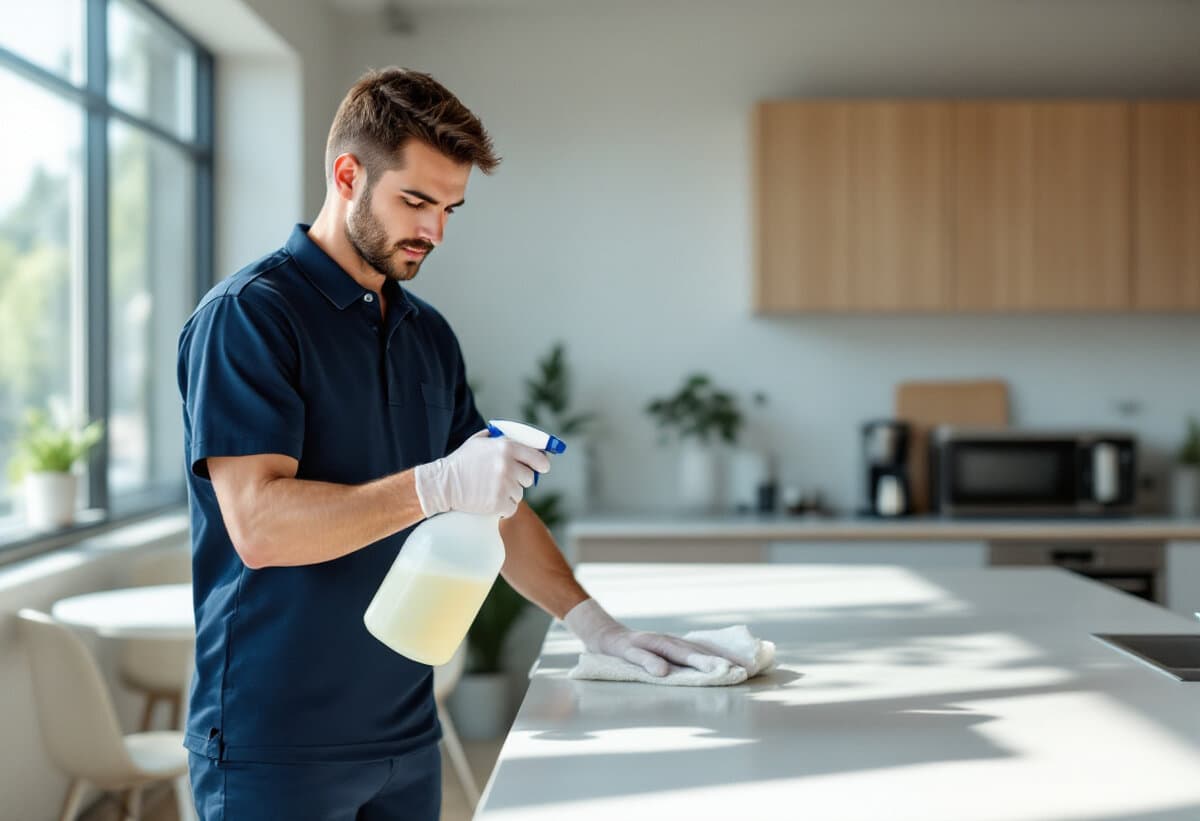
- Damp methods over dry methods. Dry dusting and dry sweeping during a smoke event resuspend fine particulate back into the air instead of removing it — you're redistributing the problem, not solving it. Damp microfiber wiping and HEPA-filtered vacuuming capture particulate instead of scattering it.
- HEPA-filtered vacuums for floors and carpet. A standard vacuum without a HEPA filter exhausts fine particulate right back into the room through its own exhaust port — effectively undoing the vacuuming. This matters more during smoke season than any other time of year.
- Increased attention to entry zones. Ash and settled particulate concentrate at entrances more than anywhere else in a facility during a smoke event. Entrance matting should be vacuumed with a HEPA unit more frequently than the normal schedule calls for, and hard-surface entry floors need more frequent damp mopping.
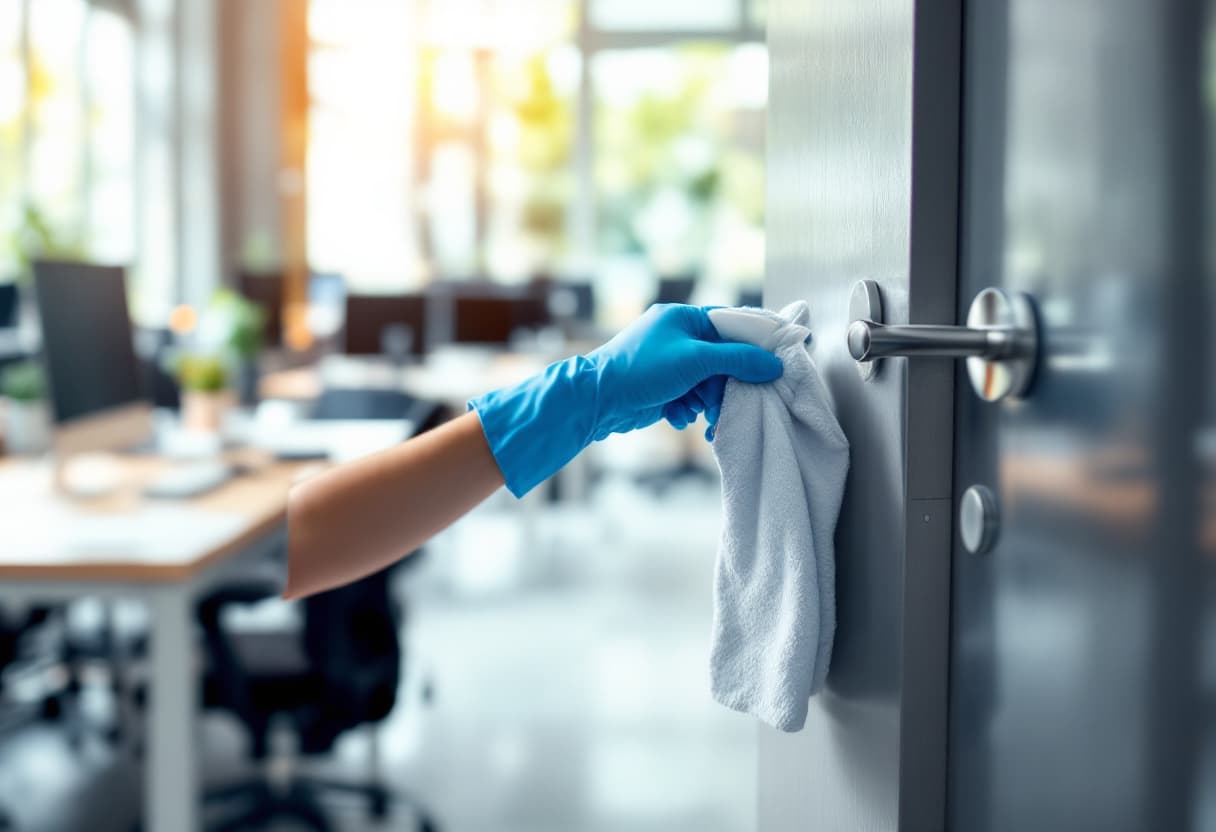
- High-touch surface disinfection stays on schedule. Smoke doesn't change pathogen exposure, but a smoke event often coincides with employees staying indoors more (windows and doors closed), which increases the value of consistent high-touch surface cleaning — door handles, elevator buttons, shared equipment.
- HVAC coil and vent dusting after a heavy smoke event. Return air vents and diffusers accumulate visible soot and particulate buildup during sustained smoke events. This is worth a dedicated pass after air quality clears, not just folded into the normal dusting rotation.
A Practical Fire-Season Playbook
Before Fire Season (Late Spring)
- Have your HVAC contractor assess whether your system can support a MERV 13 filter upgrade without airflow problems.
- Confirm whether your building automation system can manually reduce outdoor air intake, and make sure whoever manages the building knows how.
- Stage portable HEPA units for conference rooms, reception areas, and any space with extended occupancy.
- Set a monitoring habit — AirNow.gov and Nevada's own air quality tracking give real-time PM2.5 readings for Reno, Carson City, and the Tahoe basin.
During an Active Smoke Event
- Reduce outdoor air intake if your system allows it.
- Run portable HEPA units in occupied high-traffic spaces.
- Switch janitorial protocols to damp methods and HEPA-filtered vacuuming.
- Increase entry-zone matting service and hard-floor mopping frequency.
- Limit unnecessary door and dock openings where operations allow it.
After the Smoke Clears
- Inspect and clean HVAC return vents and visible diffuser surfaces.
- Do a full HEPA-filtered vacuum pass on carpet and upholstery — settled particulate works its way deep into carpet fiber over a multi-day smoke event.
- Replace HVAC filters if they've been running through a sustained heavy-smoke period — a filter loaded with wildfire particulate loses efficiency and restricts airflow.
The Regulatory Backdrop
OSHA doesn't currently have a wildfire-smoke-specific federal standard, but the General Duty Clause still applies: employers are required to provide a workplace free from recognized hazards likely to cause serious harm, and unhealthy indoor air during a smoke event can fall under that umbrella for employees with respiratory conditions or extended outdoor-adjacent work (loading docks, delivery, landscaping). This sits alongside the broader OSHA sanitation and workplace standards that already apply to Northern Nevada facilities year-round. Documenting the steps a facility takes during smoke events — filtration upgrades, cleaning frequency changes, portable air purification — is good practice both for employee health and for demonstrating a reasonable standard of care.
How Benchmark Fits In
Benchmark Commercial Cleaning adjusts janitorial protocols for smoke season across Reno and Sparks, Carson City and Dayton, Minden and Gardnerville, and Lake Tahoe. Our crews use HEPA-filtered vacuums and damp-cleaning methods as a standard part of the toolkit, and we work with clients to increase entry-zone and high-touch cleaning frequency during active smoke events.
If you'd like help building a fire-season cleaning plan for your facility, or want a walk-through of what a smoke-event response looks like for your specific building, call us at (775) 530-0456 or request a quote online.
Related Reading
Ready for a Cleaner Workspace?
Get a free, no-obligation cleaning plan customized for your Northern Nevada business.