There is no environment in a community that spreads illness faster than a school. Put twenty-five children in one room, hand them shared pencils, doorknobs, and lunch tables, add a restroom down the hall and a cafeteria at noon, and you have built a near-perfect machine for passing germs from one household to the next. Every August the machine switches back on — and the first few weeks of the school year are when absenteeism, both for students and staff, spikes hardest.
The good news is that most of that early-year illness is preventable, and the lever is not luck or hand sanitizer at the door. It's the cleaning and disinfection program running behind the scenes. This guide breaks down what a real back-to-school cleaning program looks like for schools and daycares across Reno and Sparks, Carson City and Dayton, Minden and Gardnerville, and Lake Tahoe — and how to tell a program that actually reduces sick days from one that just makes the building smell clean.
Clean, Sanitize, Disinfect — Three Words, Three Jobs
The single most expensive misunderstanding in facility care is treating these three words as synonyms. They are three separate steps, and skipping the order breaks all of them.
- Cleaning removes visible dirt, crumbs, and grime with soap and water. It doesn't kill germs — it removes the food and film they hide under.
- Sanitizing lowers the number of germs on a surface to a level public-health standards consider safe. It's the right level for food-contact surfaces like cafeteria tables.
- Disinfecting uses stronger chemistry to kill the great majority of germs on a surface. It's what high-touch, high-risk points need during cold and flu season.
The order is non-negotiable: you cannot disinfect a dirty surface. Disinfectant applied over a layer of grime never reaches the surface it's supposed to sterilize, so a crew that sprays disinfectant on a sticky desk and wipes it away in one pass has done essentially nothing. Clean first, then disinfect. This is the same discipline that separates real restroom sanitation from a quick wipe-around, and it matters twice as much in a building full of kids.
Dwell Time Is the Step Everyone Skips
Here is the detail that decides whether a disinfection program works: dwell time — also called contact time. Every disinfectant has a label-specified number of minutes it must stay wet on a surface to actually kill the pathogens it claims to. For many products that's four to ten minutes. Spray it and wipe it dry in fifteen seconds and you get the smell of disinfectant with almost none of the germ-killing.
A crew that understands dwell time works differently. They apply disinfectant to a batch of desks or door handles, move on to another task, and come back to wipe once the required contact time has passed. If your provider can't tell you the dwell time of the product they're using on classroom surfaces, that's the first question to fix — it's the difference between a sanitized room and a room that just smells like one.
Touchpoints: Where the Germs Actually Live
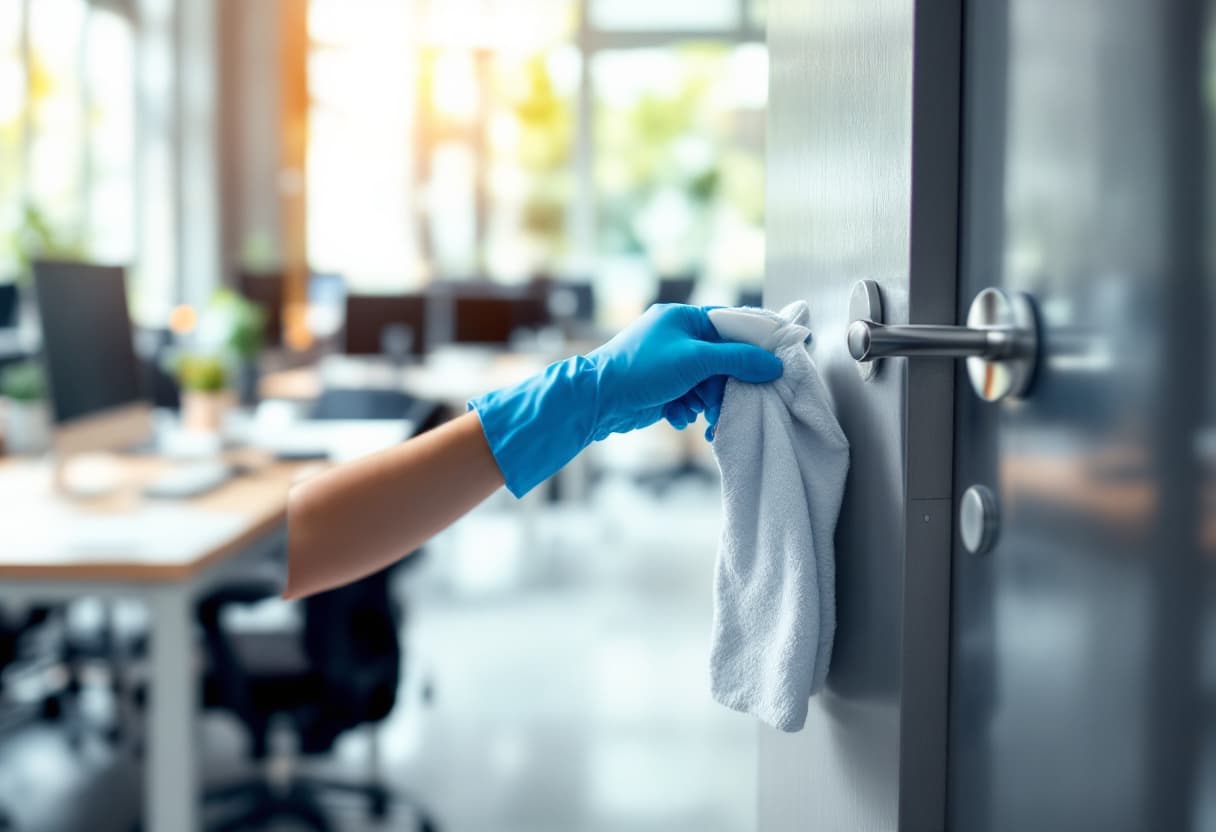
Illness doesn't spread evenly across a room. It concentrates on the handful of surfaces that dozens of hands touch every hour. In a school, the priority high-touch points are predictable:
- Door handles, push bars, and light switches
- Desk and table surfaces, chair backs
- Shared technology — keyboards, tablets, mice, and touchscreens
- Faucet handles, soap dispensers, and flush levers in restrooms
- Drinking-fountain buttons and cafeteria trays, tables, and bench tops
- Handrails, cubby latches, and shared classroom supplies
A disinfection program built around these touchpoints — hit daily, some of them multiple times a day during flu season — does far more to cut transmission than mopping every square foot of floor. This is why a good janitorial plan is targeted, not uniform: the effort follows the risk. Benchmark builds this touchpoint discipline into every janitorial services and office cleaning program, and it's the backbone of a school-specific scope.
Preventing Cross-Contamination: The Color-Coded Rule
One of the fastest ways a cleaning crew spreads germs instead of removing them is by carrying the same cloth from a restroom to a classroom desk. Professional programs prevent this with color-coded microfiber: a dedicated color for restrooms, another for general surfaces, another for cafeteria and food-contact areas. A rag that touched a toilet never touches a lunch table. It sounds basic, and it is — but it's exactly the kind of discipline that's invisible to a walk-through and enormous in its effect. Ask any prospective provider how they prevent cross-contamination; a crisp answer about color coding tells you they take it seriously.
Daycares Raise the Bar Even Higher
Everything above applies double in a childcare setting. Younger children put hands — and toys — in their mouths, crawl on floors, and have immune systems still learning the ropes, so daycares need protocols that classrooms don't:
- Toy sanitizing on a rotation — mouthed toys pulled and sanitized daily, hard surfaces and shared toys on a set schedule.
- Diaper-changing and feeding areas cleaned and disinfected as distinct zones, never cross-serviced with general cleaning cloths.
- Child-safe chemistry — products chosen for low residue and low VOCs, applied when children are out of the room and given time to dry.
- Floors treated as a surface, not a background — infants and toddlers live at floor level, so floor care and carpet cleaning are hygiene issues here, not just appearance.
The Pre-Opening Deep Clean
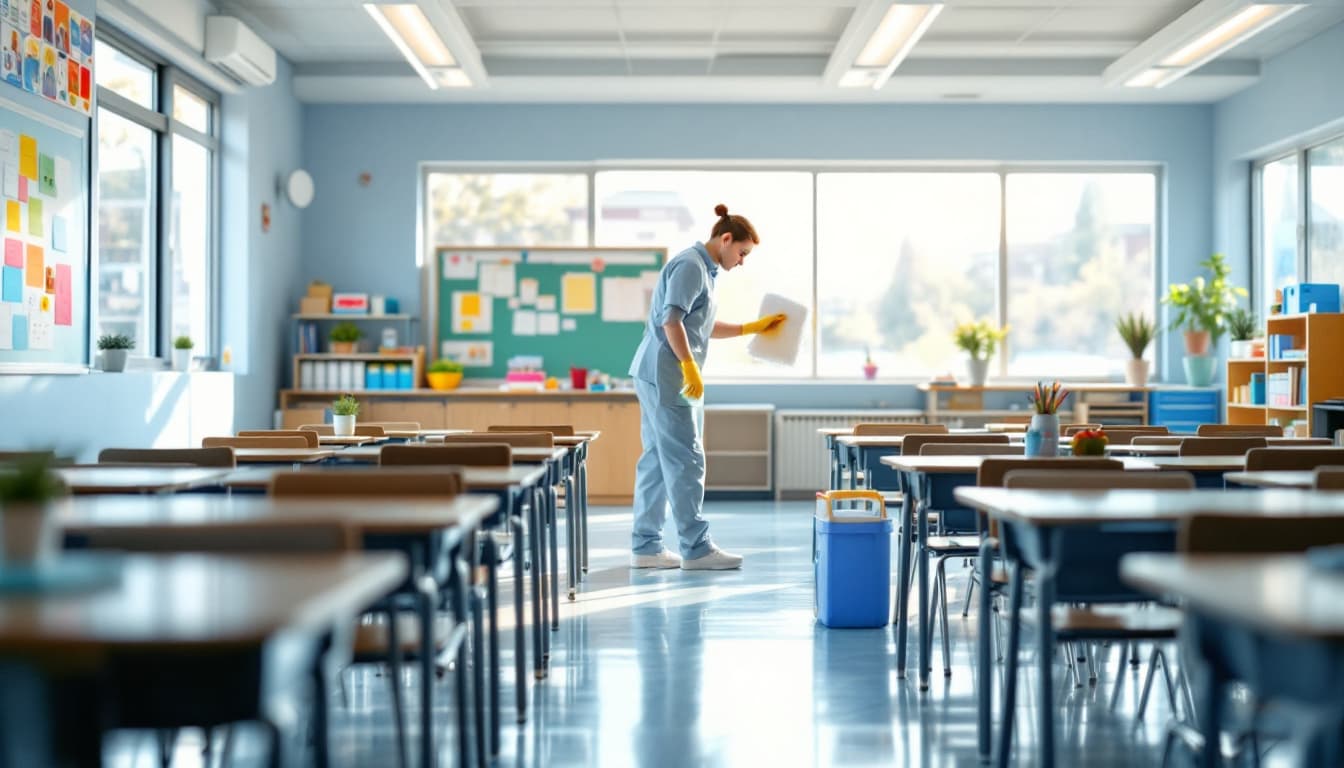
Before the first bell, a summer building needs more than a wipe-down. The weeks before opening day are the one window all year to reset every surface at once, and a proper back-to-school deep clean covers the work that can't happen while the building is occupied:
- Strip, refinish, and burnish hard floors while classrooms are empty — the ideal time for the disruptive work covered in our strip-and-wax guide.
- Deep-extract carpets in classrooms, libraries, and offices to pull out a year of embedded grit and allergens.
- Detail restrooms top to bottom — descale fixtures, disinfect every touchpoint, and handle odor at the source rather than masking it.
- Wipe down and disinfect every desk, chair, cubby, and shared surface so the building starts the year at zero.
- Clean interior glass and high-dust — vents, sills, and light fixtures that collect the dust that aggravates allergies and asthma.
Getting this deep clean done in the final weeks of summer sets the baseline; the daily and weekly program is what holds it. Our guide to maintenance between professional visits covers the in-house habits — entry matting, prompt spill response, daily touchpoint wipes — that keep a freshly reset building from sliding back by October.
Northern Nevada's Local Twist: Dust and Smoke
Our high-desert climate adds two pressures a national cleaning template ignores. Fine airborne grit rides in on every door cycle, settling into carpets and onto surfaces faster than in humid regions — which means classrooms and hallways need more frequent attention to hold air quality, not less. And late-summer and fall wildfire smoke lands right in the back-to-school window, pushing fine particulate indoors where it aggravates the asthma and allergies that already send kids home. A program tuned to Northern Nevada plans for both; one copied from a coastal district doesn't.
Why This Belongs With a Professional Crew
Schools and daycares are held to a higher standard than a typical office for good reason — the occupants are more vulnerable and the consequences of a lapse are measured in sick days, closures, and worried parents. The same infection-control thinking that governs medical and clinical spaces — clean-before-disinfect, respected dwell time, cross-contamination control, and a documented scope — is exactly what a serious school program needs. And the right cleaning frequency for a school isn't a guess; it's set by traffic, season, and the illness pressure of the calendar.
The Bottom Line
The first month of school doesn't have to be the sickest. Most early-year illness rides in on a handful of high-touch surfaces, and a disinfection program that cleans before it disinfects, respects dwell time, and prevents cross-contamination shuts down most of that transmission before it starts. Add a pre-opening deep clean while the building is empty, tune the frequency to Northern Nevada's dust and smoke, and you've traded a wave of September absences for a building that starts the year at zero.
Benchmark builds school and daycare programs around exactly this — a pre-opening deep clean, touchpoint-focused daily disinfection, color-coded cross-contamination control, and floor and carpet care scheduled while classrooms are empty. Serving schools and childcare centers across Reno-Sparks, Carson City, and the Tahoe corridor. Call (775) 530-0456 or request a free quote and we'll walk your building before the first bell.
Ready for a Cleaner Workspace?
Get a free, no-obligation cleaning plan customized for your Northern Nevada business.