Cold and flu season doesn't announce itself. It shows up quietly — one employee comes in a little under the weather, touches the door handle, the shared printer, the break-room fridge, and the coffee pot, and by Friday a third of the floor is coughing or calling out. In an office, respiratory viruses don't spread person to person so much as person to surface to person, and the surfaces doing the spreading are the ones everyone touches and no one thinks about. Getting ahead of that is the single highest-return thing a Northern Nevada business can do between October and March, and it starts with understanding what real disinfection actually involves.
This guide breaks down the difference between cleaning, sanitizing, and disinfecting, the one step almost everyone skips, the surfaces that matter most, and how to build a seasonal plan that keeps your team at their desks instead of at home.
Cleaning, Sanitizing, and Disinfecting Are Three Different Jobs
These words get used interchangeably, and that confusion is exactly why so many workplaces think they're protected when they aren't. They describe three distinct levels of work:
- Cleaning removes visible dirt, dust, and grime from a surface with soap or detergent and water. It lowers the number of germs by physically carrying them away, but it doesn't kill them.
- Sanitizing reduces germs on a surface to a level considered safe by public-health standards. It's a step up from cleaning but it isn't designed to wipe out viruses.
- Disinfecting uses an EPA-registered chemical to actually kill viruses and bacteria on a hard surface. This is the level that matters against influenza and the common cold — and it only works when it's done correctly.
The critical detail: you can't disinfect a dirty surface. Grime shields germs from the chemical, so disinfecting a surface that hasn't been cleaned first is mostly wasted effort. Real protection is a two-step sequence — clean, then disinfect — which is exactly the discipline a professional office cleaning program is built around, and the same distinction we drew for restroom sanitation: "wiped down" and "disinfected" are not the same thing.
Dwell Time: The Step Almost Everyone Skips
If there's one thing that separates disinfection that works from disinfection theater, it's dwell time — also called contact time. Every EPA-registered disinfectant has a required window, usually printed on the label, during which the surface must stay visibly wet for the product to kill what it's rated to kill. Depending on the product, that's anywhere from 30 seconds to as much as ten minutes.
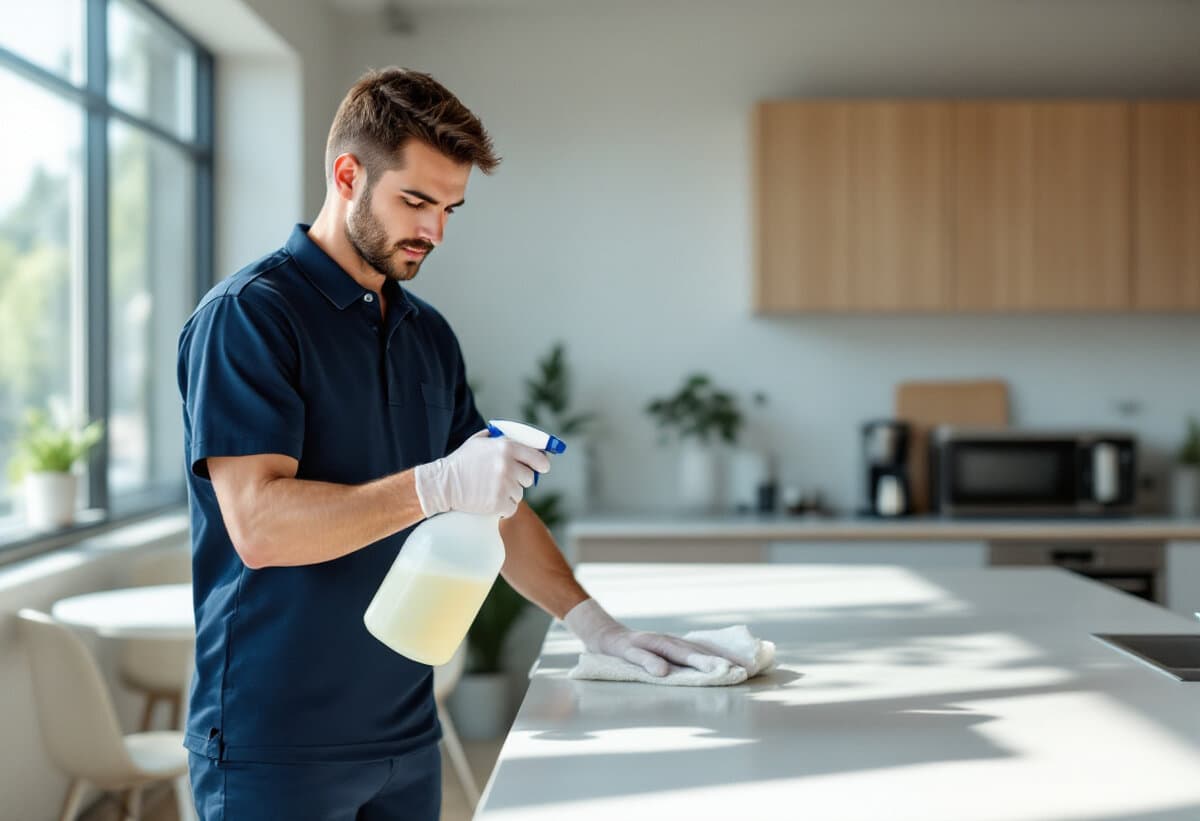
Here's the mistake nearly everyone makes: spray, and immediately wipe dry. Wiping the product off before its dwell time is up means the virus was never actually killed — the surface just looks clean. A busy employee racing through the break room between meetings almost never lets a disinfectant sit for four minutes, which is why casual, in-house wipe-downs give a false sense of security. Trained cleaning crews plan around dwell time on purpose: they apply the right product to the right surface and let it work before wiping, or let it air-dry entirely. It's an unglamorous detail, and it's the whole ballgame.
Map Your High-Touch Surfaces — Then Hit Them on a Schedule
Not every surface carries the same risk. Viruses travel through the points that the most hands touch the most often, and in a typical office those are predictable. Build your plan around them:
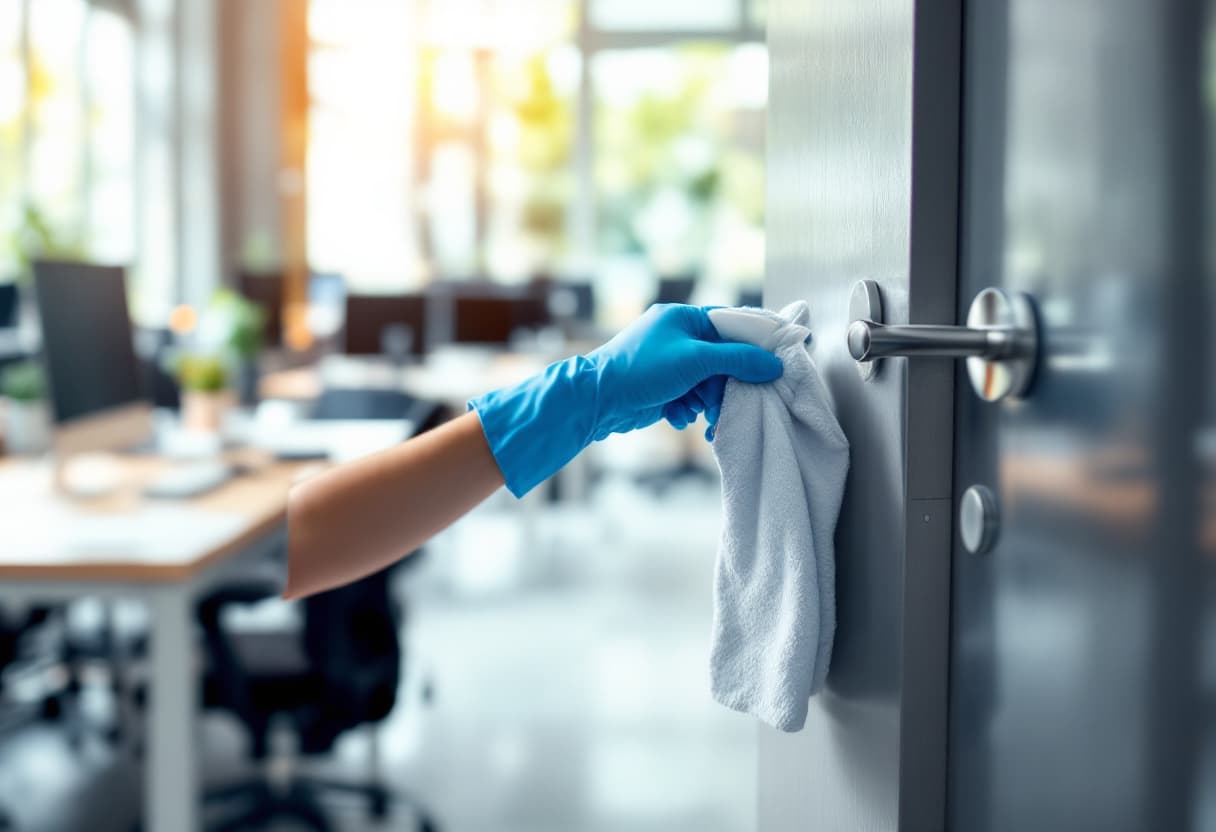
- Entry and circulation: door handles, push bars, and the front-desk counter — the first thing every person touches on the way in.
- Shared equipment: printers and copiers, keypads, touchscreens, the shared conference-room remote, and any hot-desk keyboard or mouse.
- Break rooms and kitchens: the refrigerator handle, microwave and appliance buttons, coffee-machine controls, sink faucets, and vending buttons — statistically some of the germiest spots in any workplace.
- Restrooms: faucet handles, stall latches, dispenser levers, and light switches (covered in depth in our restroom sanitation guide).
- The overlooked ones: light switches, elevator buttons, stair rails, thermostat panels, and phones — the surfaces no one pictures but everyone touches.
Frequency is what turns that map into protection. During flu season, high-touch surfaces need attention multiple times a day, not once a night. The practical pattern most workplaces land on is a two-layer rhythm: daytime touchpoint passes that quickly hit the highest-traffic surfaces while the office is occupied, plus a thorough clean-and-disinfect after hours by the janitorial team so every surface starts the next day fresh. This is a seasonal escalation of your normal routine — the same logic behind matching cleaning frequency to how a space is actually used.
What Your Team Can Do Between Professional Visits
Professional disinfection sets the baseline; daily habits hold it. A few low-effort practices make a real difference between visits — and they layer neatly on top of the maintenance routine that keeps a facility cleaner day to day:
- Put alcohol-based hand sanitizer (60%+) at the entrance, in the break room, and near shared equipment, and keep it stocked.
- Give staff EPA-registered disinfecting wipes for their own desks, phones, and keyboards — personal gear rarely gets touched by the cleaning crew.
- Enforce a real stay-home-when-sick policy. One employee toughing it out at their desk can seed an entire department; the cheapest infection control is an empty chair for a day.
- Keep restrooms stocked with soap and paper towels — proper handwashing still outperforms almost every other intervention.
Why Northern Nevada's Winter Makes This Harder
Our high-desert climate stacks the deck against you in the colder months. Winter air here is exceptionally dry, and dry indoor air lets respiratory droplets stay airborne longer and dries out the nasal passages that are your first line of defense — a combination that helps viruses spread more easily. Add the heating season, when buildings are sealed up tight and everyone is indoors and closer together, and offices become far more efficient at passing germs around than they are in summer. It's the same sealed-building, shared-air dynamic we flagged for wildfire smoke and indoor air quality — except in winter the thing circulating is a virus. A cleaning program that eases off in the winter has it exactly backwards; this is the season to increase frequency, not coast.
Healthcare and Medical Facilities: A Higher Bar
Everything above is the baseline for a standard office. Clinics, dental practices, urgent cares, and medical offices operate under a stricter standard entirely — they're seeing sick patients by definition, which means exam-room turnover disinfection, waiting-room touchpoints, and clinical surfaces all demand hospital-grade products, documented protocols, and crews trained in infection control. That's a different discipline from office cleaning, and it's the reason medical office cleaning is handled as its own specialized service rather than an add-on. If your facility sees patients, flu season isn't a nuisance — it's the busiest and highest-stakes stretch of your year, and the cleaning has to match.
The Bottom Line
Cold and flu season absenteeism isn't inevitable — it's largely a surface problem, and surface problems have surface solutions. The workplaces that stay staffed through the winter are the ones that clean before they disinfect, respect dwell time, hit the right high-touch surfaces multiple times a day, and lean into the season instead of easing off. Do that, and you spend the winter running your business instead of covering for an empty floor.
Benchmark builds seasonal disinfection into office cleaning, janitorial, and medical office cleaning programs across Reno-Sparks, Carson City and Dayton, and the Lake Tahoe corridor — EPA-registered disinfectants applied with correct dwell time, high-touch surface routines scaled up for flu season, and crews who know the difference between wiped down and actually disinfected. Call (775) 530-0456 or request a free quote and we'll build a plan around your building before the season peaks.
Related Reading
Ready for a Cleaner Workspace?
Get a free, no-obligation cleaning plan customized for your Northern Nevada business.