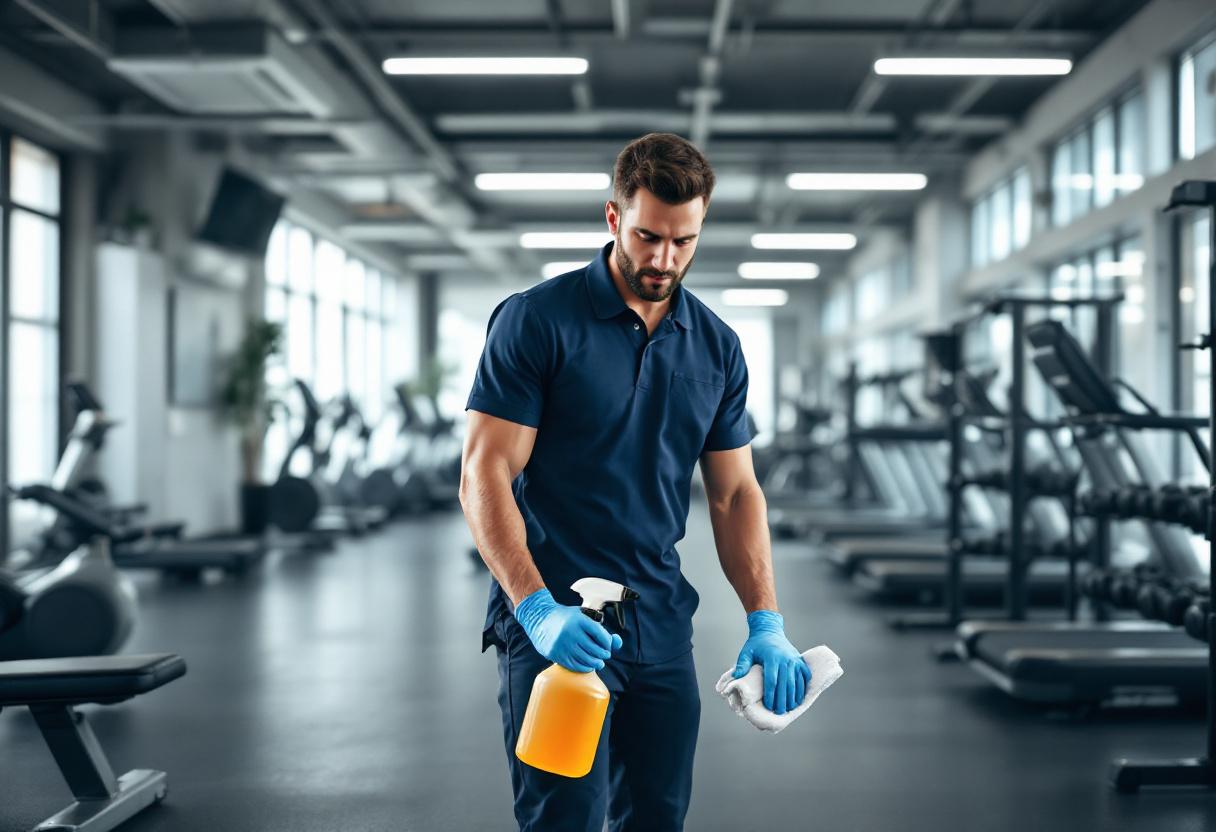
Walk into almost any fitness center and you'll find the entire cleaning program hanging on the wall: a spray bottle of blue liquid and a roll of paper towels, with a laminated sign asking members to wipe down equipment after use. It's a nice gesture. It is not a cleaning program. A gym concentrates more sweat, bare skin, warm damp air, and shared high-touch surfaces into a few thousand square feet than almost any other kind of commercial building — and heading into January, when every Northern Nevada gym fills with New Year's resolution crowds, that concentration is about to multiply.
Members notice. Survey after survey finds that cleanliness is one of the top reasons people choose a gym and the top reason they quit one. A sticky bench, a grimy locker room, or a single visible outbreak of skin infection does more to empty a membership roster than any competitor's price. The good news is that a fitness center's germ problem is completely manageable — but only with a real, room-by-room program that understands what it's actually up against. Here's what that looks like.
Why a Gym Is the Germiest Building You'll Walk Into All Week
Four things combine in a fitness center that rarely line up anywhere else. People sweat, which coats every handle and bench in a warm, nutrient-rich film that microbes love. People touch the same equipment in rapid succession — a dumbbell handled by forty different people in an hour. People expose bare skin to shared surfaces: hands on grips, backs on benches, feet on locker-room floors. And the building itself runs warm and humid, the exact conditions bacteria and fungi need to survive between users.
That's why the organisms a gym has to worry about go well beyond the ordinary cold and flu viruses we cover in our office disinfection guide. Fitness centers are a known reservoir for Staphylococcus aureus, including antibiotic-resistant MRSA, which spreads through skin contact with contaminated equipment and causes stubborn skin infections. Locker rooms and showers breed the fungi behind athlete's foot and ringworm. Mats and benches can carry plantar warts and the viruses behind hand, foot and mouth disease. And in winter, the same norovirus and influenza circulating everywhere else get a shared-surface superhighway. None of these care how new the equipment is.
The "Member Wipe-Down" Is Not Disinfection
The honest problem with the spray-bottle-on-the-wall model isn't that members are lazy — it's that even the conscientious ones can't disinfect a surface the way the process actually requires. Every disinfectant has a contact time: the surface has to stay visibly wet for a set number of minutes for the chemical to kill what's on it. A member who spritzes a bench and immediately wipes it dry hasn't disinfected anything — they've cleaned off the visible sweat and left the germs behind. In the dry Northern Nevada air, a thin wipe of disinfectant can flash off in well under a minute.
There's a second trap. Wiping one surface with a cloth that just wiped another doesn't remove germs; it spreads them. A single rag dragged from a cardio handle to a weight bench to a yoga mat is a germ-distribution system. This is exactly the failure a color-coded microfiber system is built to stop — fresh, correctly saturated cloths assigned by zone so nothing travels from the locker room back to the workout floor. Member self-service is a useful supplement between deep cleans. It is not the deep clean, and treating it as one is how a gym looks maintained while the bench you're lying on tells a different story. The only way to know which you have is to measure the surface rather than trust that it looks fine.
The Workout Floor: High-Touch Points First
A professional program starts by mapping the surfaces hundreds of hands actually touch and disinfecting those on a defined rotation — not wiping everything once and calling it even. On a gym floor the real high-touch inventory is long: dumbbell and barbell grips, cable attachments and pull-up bars, cardio-machine handrails and control panels, adjustment pins and seat levers, kettlebell handles, and the touchscreens that now sit on every treadmill.
Each gets cleaned to remove sweat and soil first, then disinfected with a product kept wet for its full contact time — because, as with any disinfecting job, you can't spray a dirty surface clean. Upholstered benches and pads need a disinfectant that won't crack the vinyl; electronics need the right wipe, not a soaked one. This is skilled, methodical work on a schedule — the difference between a gym that's genuinely disinfected and one that merely smells of citrus cleaner.
Locker Rooms and Showers: The Part Nobody Wants to Think About
If the workout floor is the germiest room by traffic, the locker room is the germiest by conditions. Warm, wet, and walked through barefoot, it's the ideal home for the fungi and bacteria that cause the infections members dread most. A real locker-room program treats it like the high-stakes wet space it is: showers and floors disinfected with a fungicidal product daily, benches and lockers and handles wiped, drains kept clear, and the tile and grout deep-cleaned on a schedule before it turns dark and starts holding odor. The attached restrooms get the same sanitation standard — not just "wiped down" — that any commercial restroom demands, with touch points and fixtures disinfected, not just the visible surfaces.
Floors, Mats, and the Air
Gym floors take a beating most commercial floors never see: dropped weights, dragged equipment, rubber and turf and foam surfaces that each want a different cleaning method. Rubber flooring scrubbed with the wrong chemical degrades; turf traps sweat and grime that only extraction reaches; stretching mats are bare-skin contact zones that need disinfecting, not just a quick sweep. Matching the method to each surface is the core of real commercial floor care, and it's also what protects the equipment and the floor investment underneath. A proper entryway matting system at the doors stops a surprising amount of winter grit, salt, and moisture before it ever reaches the floor — the cheapest upgrade most gyms are missing.
Then there's the smell. That unmistakable "gym odor" isn't an air-freshener problem; it's bacteria breaking down sweat on soft surfaces and in drains. Mask it and it comes right back. Remove the source — disinfected equipment, clean mats, clear drains, laundered towels — and the smell goes with it. Clean air and a clean-smelling room are a byproduct of actual cleaning, not a spray that covers for its absence.
The One Thing Gyms Get Wrong About Timing
Most cleaning problems in a fitness center aren't about what gets cleaned but when. A gym's dirtiest hours are its busiest — the 6 a.m. rush, the lunch crowd, the 5-to-8 p.m. peak — and a crew that only comes after close leaves those surfaces to accumulate all day. The highest-traffic fitness centers pair a thorough nightly deep clean with a daytime day porter who keeps high-touch points, locker rooms, and restrooms disinfected during peak hours, when it actually matters. How often each zone needs attention depends on the space and the crowd — which is exactly the judgment a cleaning frequency matched to your building is built to get right.
How to Tell a Real Gym Cleaning Program From a Prop
When you're evaluating a cleaning partner for a fitness center, the questions that matter aren't about how often someone walks the floor with a spray bottle. Ask whether they clean before they disinfect, whether they hold the full contact time on equipment, whether they use a zoned, color-coded cloth system so germs don't travel from the locker room to the squat rack, whether they treat the locker room and showers as a fungicidal wet-space job rather than a quick mop, and whether they offer daytime coverage for peak hours. A provider who can answer those is selling health. A provider who points at the wall-mounted spray bottle is selling you the same program your members already don't trust.
The Bottom Line
A fitness center sells one thing above all: a place people feel good about spending time in their own skin. Nothing undermines that faster than a gym that looks or smells unclean — and nothing protects it better than a program built for the specific, demanding reality of the space. The sweat, the shared equipment, the humid locker rooms, and the January crowds aren't going away. The germs they create are entirely manageable with the right room-by-room plan, run by people who know the difference between wiping a surface and disinfecting it.
Benchmark builds complete, health-focused cleaning programs for gyms, studios, and fitness centers across Northern Nevada — equipment and high-touch disinfection done to contact time, fungicidal locker-room and restroom care, specialized floor care for rubber, turf, and mats, and daytime janitorial coverage when your floor is busiest. We serve offices, medical facilities, fitness centers, and more across Reno-Sparks, Carson City and Dayton, Minden and Gardnerville, and the Lake Tahoe area. Call (775) 530-0456 or request a free quote, and we'll build a plan that's ready before the New Year rush walks through your doors.
Related Reading
Ready for a Cleaner Workspace?
Get a free, no-obligation cleaning plan customized for your Northern Nevada business.